


Last Updated: November 2, 2026
Quick Summary
Fleet telematics combines GPS tracking, vehicle sensors and software to show where your vans are, how they are driven and when they need servicing. For small businesses, this live visibility helps cut fuel waste from idling and harsh driving, reduces admin, and keeps HMRC mileage records accurate.
- Idling is a common source of fuel waste that telematics can flag by driver and week.
- Share monthly fuel-use figures with drivers and agree one target at a time.
- Maintenance alerts based on real mileage help protect resale value and reduce breakdown risk.
- Automatic journey logs create the record HMRC expects before anyone has to remember trips.
- Check that mileage exports suit your accounting software and separate business from private journeys.
Table of Contents
- What Fleet Telematics Means for a Small Business Fleet
- Reducing Fleet Fuel Costs in the UK
- Improving Driver Safety and Behaviour
- Keeping Vehicle Maintenance and HMRC Mileage Records in Order
- Whole Life Cost Analysis for Vans: Where Telematics Fits
- Planning Your Electric Vehicle Fleet Transition
- Booking a Fleet Review With OVL Group
- Frequently Asked Questions
What Fleet Telematics Means for a Small Business Fleet
Fleet telematics is the combination of GPS tracking, onboard vehicle sensors and software that reports on where your vans are, how they are being driven and how they are performing.
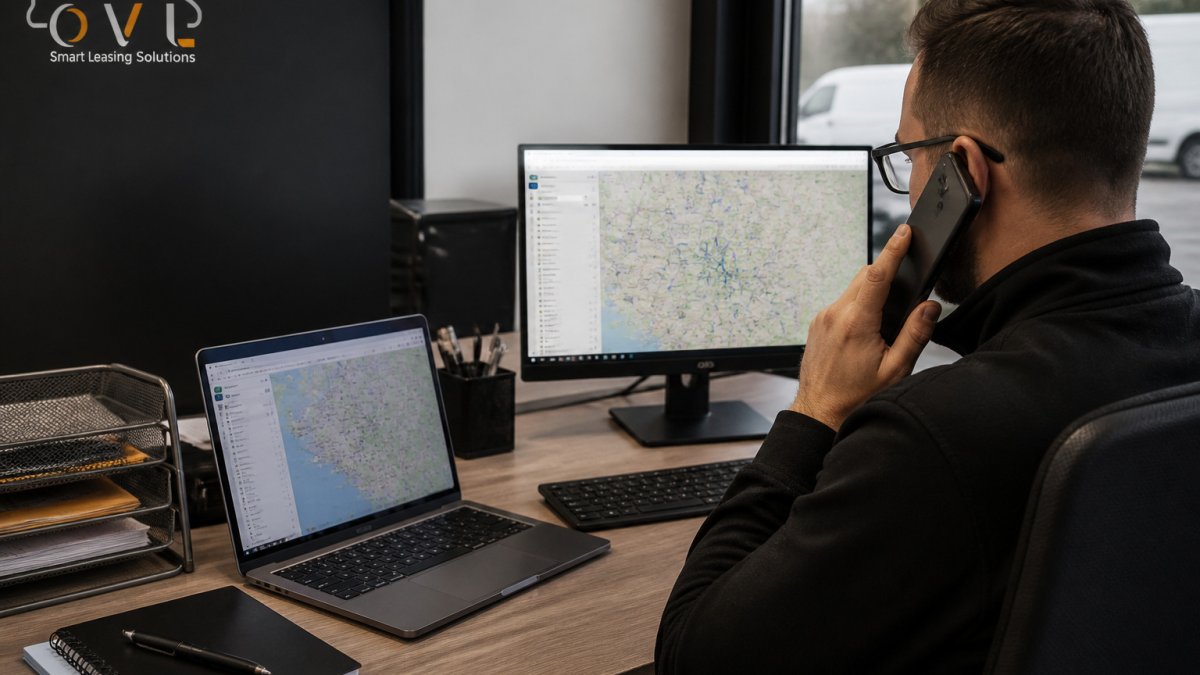
Telematics units can connect to the vehicle's diagnostic port and send data such as location, speed, harsh braking, idling and mileage to a dashboard you can check from an office or a phone. To compare providers that handle compliance and servicing schedules, see fleet management companies for vans.
The practical benefit is visibility. You stop relying on drivers' verbal reports and start working from the same data every time. That is the foundation for the cost and admin savings covered below.
Reducing Fleet Fuel Costs in the UK
Fuel is usually the largest single running cost for a small van fleet after finance, and it is where telematics tends to pay back fastest. The reason is mechanical rather than magical: telematics measures the inputs that drive fuel burn, idle time, harsh acceleration, over-revving, excessive speed and route choice, and reports them per vehicle, per driver and per day. Once those inputs are visible, they can be managed.
Where the fuel actually goes
Three patterns account for most of the waste a small fleet sees in its first months of telematics data:
- Idling. A van left running outside a customer's premises, at a loading bay or during a doorstep call burns fuel without moving. Telematics can flag idle events over a set threshold and total them by driver and by week. Idling also accelerates engine wear and, in built-up areas, contributes to local air-quality problems that matter under clean-air zone rules.
- Harsh acceleration and late braking. These are the signature of a stop-start driving style. They raise fuel consumption and brake wear together, so the saving shows up in two cost lines, not one.
- Route and journey choice. Telematics shows the actual route taken against the planned one, so you can see where drivers are adding miles through poor sequencing or avoidable detours. For a small fleet doing multi-drop work around a city such as Oxford, a handful of extra miles per van per day compounds quickly across a month.
How to turn the data into a saving
The pattern that works for small fleets is coaching, not policing. Share each driver's fuel-use figures with them monthly, agree one target at a time (idle time is usually the easiest first target), and review progress together. A driver who can see their own trend improve is far more likely to keep it up than one who is simply told off.
Watch out: if you introduce telematics as a disciplinary tool, drivers will find ways to work around it, unplugging units, sharing vehicles to muddy the data, or simply disengaging, and the fuel saving evaporates. Explain the purpose before the units go in.
The small-business trade-off
The saving can vary between fleets. Vans on very short, fixed local routes with lots of legitimate idling (refrigeration units, for example) will show less benefit than vans on variable multi-drop work. Before committing, ask a supplier to show you a sample report from a fleet of a similar size and duty cycle, and check that the subscription cost is comfortably below the fuel and wear saving you expect. For a fleet of three to ten vans, savings can come from idling and driving-style coaching first, with route optimisation as a later gain once drivers are used to the system.

The article sets out where small fleets typically lose fuel and how to tackle each pattern.
| Waste pattern | What it looks like | Suggested response |
|---|---|---|
| Idling | Van left running at premises, loading bays or doorstep calls | Flag idle events over a set threshold and total them by driver |
| Harsh acceleration and late braking | Stop-start driving style | Coach drivers; saving shows in fuel and brake wear |
| Route and journey choice | Extra miles from poor sequencing or detours | Compare actual route against planned route |
| Unmanaged driving habits | Waste that continues without review | Share monthly figures and agree one target at a time |
Improving Driver Safety and Behaviour
Telematics can record harsh braking, rapid acceleration and sharp cornering, which are useful indicators of driving style (Employers - driving and riding safely for work - Plan and manage journeys). Tracking these events can help you spot patterns early.
Safety data works best when drivers understand what is measured and why. Set out clearly that the purpose is safety and fair coaching, and use the reports to start conversations rather than to issue penalties. A driver who sees their own trend improve is far more likely to keep it up.
For insurance matters, speak to a qualified insurance adviser.
Pros: Early warning of risky driving, supports fair coaching, shows improvement over time. Cons: Can feel intrusive if introduced badly, and alerts need proper review or they become noise.
Keeping Vehicle Maintenance and HMRC Mileage Records in Order
Admin is where many small fleets lose the most time, and it is the area where telematics quietly earns its keep. Two jobs dominate: keeping vehicles serviced on the right schedule, and keeping mileage records that satisfy HMRC.
Maintenance on real mileage, not guesswork
Service intervals are set by mileage or time, whichever comes first. Without telematics, a small business is often guessing, relying on drivers to report odometer readings, or discovering at MOT time that a van has run well past its service interval. Telematics can use recorded mileage to flag when a service, inspection or tyre check may be due based on actual use. That protects resale value, reduces breakdown risk and gives you a defensible maintenance history if you ever sell or part-exchange the vehicle.
Watch out: reminders are only useful if someone acts on them. Assign one person to review the maintenance dashboard weekly, or the alerts become background noise.
HMRC mileage records
HMRC expects a clear record of business journeys, including the date, destination, purpose and mileage. For a small business, the risk is not deliberate misclaiming, it is missing trips because the record was kept in a notebook, a spreadsheet or a driver's memory. Telematics logs journeys automatically, so the record exists before anyone has to remember it.
A typical workflow is that telematics captures the journey, you tag it as business or private, and the tagged log feeds your accounts. Private journeys still need to be separated out, because HMRC expects a clear distinction between business and private use, particularly where a van is available for private use and a benefit-in-kind charge may apply. Check the current HMRC guidance on mileage records and benefit-in-kind for vans before you rely on any single method.
The integration angle most guides miss
The admin saving can be greater when telematics data flows into the accounting software a business already uses.
Before you choose a telematics supplier, ask two questions: does it export mileage in a format your accounting software can ingest, and does it separate business and private journeys at the point of capture? If the answer to either is no, you will still be doing the reconciliation manually, and much of the admin benefit disappears.
If you are comparing ways to manage servicing and records, you can review our fleet maintenance software guide and how neglected fleet maintenance affects costs and compliance.
Whole Life Cost Analysis for Vans: Where Telematics Fits
Whole life cost looks beyond the monthly payment to cover finance, fuel, servicing, maintenance, insurance and tax. Telematics data feeds directly into that picture, because it shows how each van is actually used rather than how it was expected to be used.
When you know a van's real mileage, idling pattern and servicing history, you can judge its true running cost more accurately. For a broader view of outsourced options, see our outsourced fleet management services guide and our guide to managing van fleet maintenance and compliance.
Pros: Real usage data for cost modelling, better timing for replacement decisions, clearer picture of running costs. Cons: Full whole life costing still needs finance and tax input, and telematics only covers the costs it can observe.
Planning Your Electric Vehicle Fleet Transition
Electric vehicles change how a fleet is managed. Range, charging availability and route planning all matter, and telematics can show whether a van's typical daily mileage suits battery capacity. Where a route regularly exceeds realistic range, the data will show it.
Start by mapping which vehicles cover predictable routes and which cover variable ones. Predictable routes are often better candidates for early electric adoption, because their mileage can be checked against real data. Our electric and hybrid leasing options and lease used electric vehicles pages outline what is available.
Pros: Data-backed decisions on which vehicles to switch first, clearer charging planning, lower risk of range problems. Cons: Telematics does not replace charging infrastructure planning, and the transition still needs a clear budget and timescale.
Booking a Fleet Review With OVL Group
OVL Group works with businesses to plan vehicle leasing and fleet management around real operating needs, covering cars, electric vehicles, vans and minibuses. Our team focuses on whole life cost analysis and dedicated account management, so the advice you receive is tailored to your fleet rather than a generic package.
As one customer put it, "Neil and the team at OVL are the best when it comes to helping arrange a new car. The support and advice is second to none! Attentive and helpful all the way." Browse our current vehicle leasing special offers or van leasing special offers to see what is available now, and arrange a fleet review to discuss your numbers in detail.
Frequently Asked Questions
How does fleet telematics help with HMRC compliance?
Telematics records journey start and end times, distances and locations automatically, which gives a small business a dated log of business mileage. HMRC expects business mileage to be recorded accurately so that claims for the approved mileage allowance or company car benefit calculations can be supported. A telematics report can be exported when needed, so the figures are ready for your accountant or an HMRC enquiry rather than reconstructed from memory. Your accountant can confirm exactly what records your business needs to keep.
Is telematics cost-effective for a small fleet of under 10 vehicles?
It can be, particularly where fuel, mileage claims and admin time are significant. For a fleet of under 10 vehicles the value comes from reduced fuel use, fewer unnecessary journeys, quicker maintenance scheduling and less time spent compiling mileage records. Costs depend on the hardware, the software package and the contract length, so there is no fixed figure to quote here. Speak to OVL Group for a quote tailored to your fleet size and needs.
What are the primary operational benefits of GPS tracking for vans?
GPS tracking shows where each van is at any time, which helps with despatching, customer arrival times and recovering stolen vehicles. It also reveals idling, harsh braking and speeding, which feed directly into fuel use and driver safety. Over time, the location history highlights routes that can be shortened and vans that are underused, so you can decide whether a vehicle is needed at all.
Does telematics help reduce fuel consumption for small businesses?
Yes, because it highlights the behaviours that waste fuel, such as excessive idling, heavy acceleration and speeding. Managers can use this data to coach drivers and plan more efficient routes. The savings vary by fleet, driving pattern and how consistently the data is acted upon, so the results should be measured on your own vehicles rather than assumed.
Ready to see where your fleet is losing money and time? Get in touch with OVL Group for a fleet review, and we will walk through your vehicles, your running costs and the options that suit your business.


