



Table of Contents
- What Fleet Maintenance Software Actually Does
- Fleet Maintenance Software Benefits That Impact Your Bottom Line
- Preventative Maintenance vs Reactive Maintenance: The Cost Difference
- DVSA Vehicle Maintenance Standards and Compliance Reporting
- Calculating ROI: Using a Fleet Management Software ROI Calculator
- Hidden Costs and Implementation Realities
- Is Fleet Maintenance Software Right for Your Operation?
- Conclusion
Last Updated: August 15, 2026
What Fleet Maintenance Software Actually Does
Fleet maintenance software is a digital platform that automates the tracking, scheduling, and management of vehicle maintenance tasks across your entire fleet. It replaces manual logbooks, spreadsheets, and phone calls with centralised systems that monitor vehicle health, trigger maintenance alerts, and generate compliance reports in real time.
The software connects to your vehicles through telematics integration, collects data on engine performance and component wear, and uses that information to schedule preventative maintenance before problems become expensive failures. It tracks service history for every vehicle, assigns work orders to technicians, manages parts inventory, and documents everything for regulatory compliance.
Most fleet maintenance software systems include work order management, automated alerts, service history tracking, parts inventory management, and compliance reporting. Some platforms also integrate with your accounting system, so maintenance costs flow automatically into your financial records.

For field service companies managing 50+ vans, this centralisation is critical. You cannot track preventative maintenance intervals across dozens of vehicles using spreadsheets without errors. Compliance becomes a nightmare when DVSA inspectors ask for service records and you're hunting through folders. The software solves these problems simultaneously.
Fleet Maintenance Software Benefits That Impact Your Bottom Line
The business case for fleet maintenance software rests on three measurable outcomes: reducing unplanned downtime, extending vehicle lifecycle, and cutting total cost of ownership.
Unplanned downtime is the silent killer of fleet operations. A van breaks down unexpectedly, your technician is unavailable, the customer job gets delayed, and you lose revenue plus emergency repair costs. Preventative maintenance eliminates most of these surprises. When you schedule service in advance, the vehicle doesn't fail at the worst possible moment.
Vehicle lifecycle management becomes measurable with software. You can see exactly how many kilometres each vehicle has travelled, what maintenance it has received, and how its condition compares to others in your fleet. This data tells you when to retire a vehicle before repair costs spiral.
The third benefit is total cost of ownership optimisation. This includes repair costs, fuel consumption tracking, insurance implications of poor maintenance records, and the capital expenditure of replacing vehicles prematurely. A well-maintained vehicle lasts longer, uses less fuel, and qualifies for better insurance rates. If you're leasing your fleet, understanding maintenance impact on whole life cost is particularly important, Van Leasing Special Offers and Vehicle Leasing Special Offers often include maintenance packages that work hand-in-hand with fleet maintenance software to optimise your operational costs.
Operational efficiency improves because technicians spend less time on paperwork and more time on repairs. Work orders arrive on their mobile device, they complete the job, they submit the record, no manual entry, no lost paperwork. This also improves driver safety. When your fleet is properly maintained, drivers experience fewer breakdowns, which means fewer roadside incidents.
Regulatory compliance reporting becomes automated. Instead of scrambling to compile service records when DVSA asks for them, the software generates the report in minutes.
Preventative Maintenance vs Reactive Maintenance: The Cost Difference
Reactive maintenance (fixing things when they break) costs roughly three to five times more than preventative maintenance (fixing things before they break).
When you ignore an early warning sign, the component continues to degrade and cascades into secondary damage. A worn brake pad wears the rotor. A leaking seal contaminates the fluid. A loose belt strains the alternator. By the time the vehicle fails, you're replacing multiple components plus addressing secondary damage.
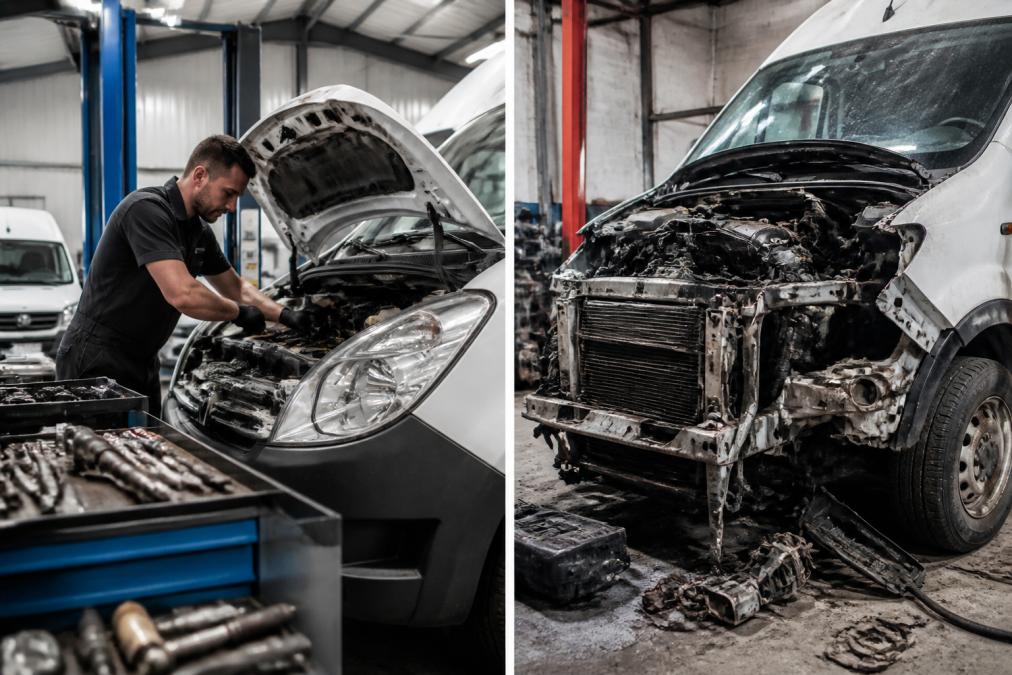
Preventative maintenance intercepts the problem at step one. You replace the brake pad before it damages the rotor. You fix the seal before it contaminates the fluid. The repair takes two hours instead of eight and costs significantly less.
Scheduled maintenance happens on your schedule, when you have capacity. Emergency repairs happen when the vehicle fails, usually at the worst possible moment, forcing you to use external garages at premium rates.
Fleet maintenance software makes preventative maintenance systematic. Instead of hoping you remember to service each vehicle on time, the software tracks every vehicle's maintenance intervals and alerts you when service is due. You schedule the work in advance, plan your technician's week, and execute the maintenance on your terms. This consistency drives the cost difference. You move from random, expensive failures to predictable, affordable maintenance.
DVSA Vehicle Maintenance Standards and Compliance Reporting
The Driver and Vehicle Standards Agency (DVSA) sets the standards for vehicle maintenance in the UK. Operators must ensure that every vehicle in their fleet is maintained to a safe standard, and they must be able to demonstrate that maintenance with records.
DVSA inspectors can stop your vehicles and check maintenance documentation. If records are missing, incomplete, or show evidence of neglect, you face penalties. If a vehicle causes an accident and the investigation reveals poor maintenance, you expose your business to liability claims and regulatory action.
Fleet maintenance software generates the compliance records DVSA requires. Every service, repair, and inspection is logged with dates, technician names, and work completed. When an inspector asks for records, you produce a report that proves your fleet meets safety standards. This documentation also protects you legally.
The software also helps you stay within the legal framework for vehicle maintenance intervals. Different vehicle types have different service schedules, and those schedules must be followed. The software tracks these intervals and ensures no vehicle exceeds its maintenance deadline.
Calculating ROI: Using a Fleet Management Software ROI Calculator
Calculating return on investment for fleet maintenance software requires you to quantify the costs you're currently paying and compare them to the costs you'll pay with software in place.
Start with your current situation. How much are you spending annually on vehicle repairs? How many unplanned breakdowns occurred last year, and what was the cost of each? How much time do your technicians spend on administrative work instead of repairs?
Next, estimate your future situation with software. Your preventative maintenance program will reduce emergency repairs. Use a conservative estimate, say you eliminate 40% of unplanned breakdowns. Your technicians will spend less time on admin. Estimate they save two hours per week per technician. Your vehicles will stay in service longer because you're maintaining them properly, so you'll delay capital replacement by 6-12 months.
A fleet management software ROI calculator helps you model these scenarios. You input your current spending, your fleet size, your typical repair costs, and your downtime losses. The calculator shows you the payback timeline and the cumulative savings over three years. Most fleet operators see positive ROI within the first year.
The key insight: you're not spending money on software, you're redirecting money you're already spending on expensive reactive repairs into cheaper preventative maintenance and better visibility.
Hidden Costs and Implementation Realities
Fleet maintenance software is not a plug-and-play purchase. There are hidden costs and implementation challenges that catch operators off guard.
First, integration with your existing systems takes time and expertise. If you use accounting software, ERP systems, or telematics platforms, the new fleet maintenance software needs to connect to those systems. This can add weeks to your implementation timeline.
Second, data migration is messy. If you have years of maintenance records in spreadsheets or old systems, getting that data into the new software requires cleaning, standardising, and uploading. This is labour-intensive and error-prone.
Third, staff training and change management are real costs. Your technicians need to learn the new system. Your office staff need to learn how to generate reports and manage work orders. Budget for 4-6 weeks of reduced efficiency as your team adjusts.
Fourth, scalability thresholds exist. The software works brilliantly for 50-200 vehicles. At 500+ vehicles, you may hit performance limits or licensing costs become prohibitive. Ask the vendor: at what fleet size does the system start to strain?
Finally, there is the cost of change itself. Some teams resist moving away from manual processes. You need a change management plan that addresses these concerns head-on. Without buy-in from your team, the software will fail to deliver its benefits.
Is Fleet Maintenance Software Right for Your Operation?
Fleet maintenance software is a strong fit if you operate 50+ vehicles, you have unplanned downtime that costs you money, your compliance reporting is manual and error-prone, or your technicians spend significant time on administrative work.
It is a weaker fit if you operate fewer than 20 vehicles (the overhead of the system exceeds the benefit), your vehicles are simple and rarely break down, or you have no compliance reporting requirements.
The decision also depends on your growth trajectory. If you're expanding your fleet, implementing software now, before you reach 100+ vehicles, is much easier than retrofitting it later. The software scales with your business, whereas manual processes become unmanageable as you grow.
Consider also your team's technical comfort. If your staff are comfortable with digital tools and mobile apps, adoption will be smoother. If your team is resistant to technology, you'll face a steeper change management challenge.
One final factor: your competitive environment. If your competitors are using fleet maintenance software and you are not, they have a cost advantage. They're running leaner, delivering better reliability, and offering better pricing. Over time, this advantage compounds. In a competitive market, the software is not optional, it's a necessity to stay competitive.
OVL Group helps fleet operators evaluate whether fleet maintenance software aligns with their operational needs and growth plans. Our whole life cost analysis includes the software investment alongside vehicle leasing, maintenance contracts, and fuel costs, so you can see the complete financial picture. Whether you're managing field service vans, domiciliary care vehicles, or a mixed fleet, including options like Electric / Hybrid Leasing or Lease Used Electric Vehicles, understanding the true cost of ownership, including the impact of preventative maintenance, is essential to making the right investment decision.
The decision to invest in fleet maintenance software ultimately comes down to whether the cost of the software is less than the cost of the problems it solves. For most fleet operators managing 50+ vehicles, that equation favours the software. The reduction in unplanned downtime, the extension of vehicle lifecycle, and the improvement in regulatory compliance typically deliver measurable savings within 12-18 months.
If you're evaluating fleet management solutions and want to understand how they fit into your overall fleet strategy, OVL Group's whole life cost analysis can help you model the financial impact. We work with field service companies, domiciliary care providers, and SMEs across the UK to optimise fleet performance and cut operational costs. Contact our team to discuss whether fleet maintenance software is the right next step for your operation.
Frequently Asked Questions
How much can fleet maintenance software reduce unplanned downtime?
Unplanned downtime costs money in lost productivity and emergency repair bills. Fleet maintenance software prevents this by automating maintenance scheduling and sending real-time alerts before problems occur. By catching issues during scheduled preventative maintenance rather than waiting for breakdowns, most fleets see significant reductions in unexpected vehicle failures. The exact reduction depends on your current maintenance practices and fleet size, but the shift from reactive to preventative scheduling is where the largest gains appear.
What is the difference between fleet maintenance software benefits and general fleet management?
Fleet maintenance software focuses specifically on vehicle upkeep, service history, parts inventory, and compliance scheduling. General fleet management covers the broader picture: routing, driver behaviour, fuel consumption, and asset tracking. While they overlap, maintenance software is purpose-built to reduce repair costs and extend vehicle lifecycle through better scheduling and data. Many operations need both systems working together, though some platforms combine them.
How does fleet maintenance software help with DVSA compliance?
DVSA vehicle maintenance standards require documented proof of regular inspections and repairs. Fleet maintenance software automatically logs all service work, generates compliance reports, and alerts you when vehicles are due for statutory checks. This removes manual paperwork and reduces the risk of missing deadlines that could result in enforcement action. The system creates an audit trail that satisfies regulatory requirements without the administrative burden.
Is fleet maintenance software suitable for smaller operations with 30-50 vehicles?
Yes. Smaller fleets often benefit most because they're drowning in spreadsheets and manual tracking. A fleet maintenance software system scales efficiently for operations of any size. The return on investment can actually be faster for smaller teams because the time savings per vehicle is more dramatic when you're managing everything manually. Start-up complexity is the main concern, but modern systems are designed for straightforward implementation.


